Global Cancer Biomarkers Market to US$58 Billion by 2032 Driven by Precision Oncology and Liquid Biopsy Advancements
Industry Experts, Inc. has released its latest market research report, "Global Cancer Biomarkers Market - Types, Applications and Technologies," estimating that the global cancer biomarkers market will expand from US$27.6 billion in 2025 to US$58 billion by 2032, registering a strong CAGR of 11.2% during 2025-2032. Growth is being driven by the rising global cancer burden, increasing emphasis on early and accurate diagnosis, and rapid adoption of biomarker-guided precision oncology.
Cancer biomarkers are measurable biological indicators that support cancer detection, prognosis, treatment selection, and therapy monitoring across a wide range of malignancies. Increasing reliance on molecular profiling to guide targeted therapies, combined with growing adoption of liquid biopsy techniques based on circulating tumor DNA (ctDNA), circulating tumor cells (CTCs), and exosomes, has significantly expanded the clinical role of biomarkers. Advances in next-generation sequencing (NGS), PCR-based assays, immunoassays, mass spectrometry, and bioinformatics are improving diagnostic accuracy, reducing turnaround times, and strengthening clinical decision-making across oncology care pathways.
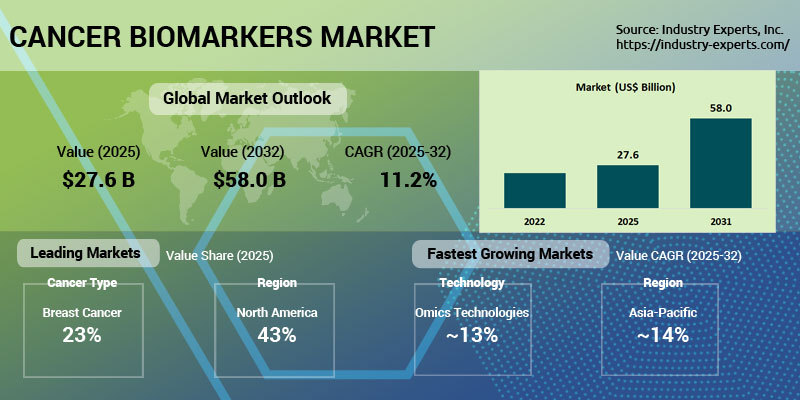
Regionally, North America dominates the global cancer biomarkers market with a 42.9% share in 2025, representing approximately US$11.8 billion, supported by advanced healthcare infrastructure, substantial R&D investment, strong regulatory support, and widespread adoption of precision medicine. High cancer prevalence, robust government funding through agencies such as the NIH and NCI, and early commercialization of biomarker-based diagnostics continue to reinforce regional leadership. Asia-Pacific is the fastest-growing region, projected to register a 13.6% CAGR during 2025-2032, driven by rising cancer incidence, expanding healthcare spending, government-backed precision oncology programs, and increasing access to advanced molecular diagnostics across China, India, Japan, and South Korea.
By biomarker type, genetic biomarkers account for the largest share at 30.5% in 2025, equivalent to approximately US$8.4 billion, reflecting widespread clinical use of BRCA1/2, EGFR, KRAS, and TP53 mutations in diagnosis and targeted therapy selection. Their strong integration into routine oncology workflows and companion diagnostics sustains demand. Meanwhile, epigenetic biomarkers represent the fastest-growing segment, expanding at a 13.5% CAGR, supported by growing clinical relevance of DNA methylation and histone modification patterns for early cancer detection and non-invasive testing.
By cancer type, breast cancer represents the largest segment with a 22.7% share in 2025, driven by high global prevalence, established screening programs, and extensive use of ER, PR, HER2, Ki-67, and multigene assays. In contrast, lung cancer is the fastest-growing segment, projected to grow at a 13.8% CAGR, supported by high disease incidence and expanding use of biomarkers such as EGFR, ALK, ROS1, PD-L1, and tumor mutational burden (TMB) to guide targeted and immunotherapy decisions.
In terms of application, diagnostics represent the largest segment with a 46% share in 2025, reflecting strong emphasis on early detection, expanding use of biomarker-based screening programs, and widespread integration of molecular diagnostics into routine oncology practice. Personalized medicine is the fastest-growing application, expanding at a 12.7% CAGR, driven by increasing adoption of biomarker-guided treatment selection, companion diagnostics, and precision oncology clinical trials.
By technology, omics technologies dominate the market with a 36.2% share in 2025, supported by their central role in biomarker discovery, molecular profiling, and precision medicine. High-throughput sequencing, advanced proteomics, and AI-enabled bioinformatics platforms continue to accelerate clinical translation. Imaging technologies remain a major contributor, supported by widespread use of PET, CT, MRI, and radiolabeled biomarker imaging for non-invasive tumor detection and monitoring.
The report segments the global Cancer Biomarkers market by biomarker type (genetic, epigenetic, metabolic, proteomic, and others), cancer type (breast, lung, colorectal, prostate, blood cancers, liver, and others), application (diagnostics, personalized medicine, drug discovery & development, and others), and technology (omics, imaging, immunoassay, cytogenetics, and others). Geographic coverage spans North America, Europe, Asia-Pacific, South America, and Rest of World, with detailed analysis across 14 independent countries, along with profiles of over 16 major companies operating in the market.
For sample pages or purchase options, contact +1-320-497-3787 or visit Cancer Biomarkers Market Report.
About Industry Experts, Inc.
Industry Experts, Inc. ranks among the leading market research providers globally. The company's off-the-shelf and customized business intelligence reports offer strategic insights and valuable guidance to enable corporate strategists, analysts, researchers, and startups in obtaining unbiased current and future market data. For more information, contact +1-320-497-3787 or visit https://industry-experts.com.


Comments
Post a Comment